Binance stock Recurring Buy plans place their orders about 90 minutes after the US open
Set the frequency, the stocks and the amount once, and the plan buys at around 10:30 ET on each scheduled day, unless the balance is short or a stock is rejected.
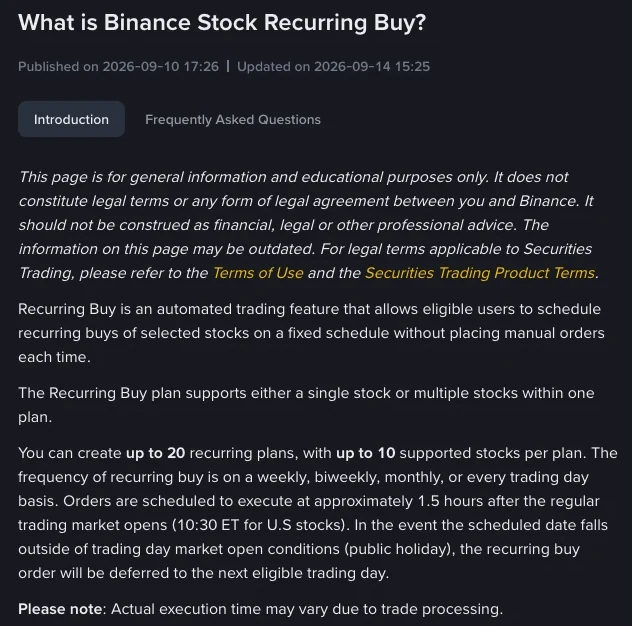
Binance Stock Trading includes Recurring Buy, which lets eligible users buy selected stocks automatically on a fixed schedule. Under [Trade] - [Stocks], find a stock that supports Recurring Buy, choose [Recurring Buy], then set the frequency, the stocks and the amount per cycle. That creates the plan, and from then on you don't have to place each order by hand.
On each scheduled day the order runs about 1.5 hours after the US regular session opens, which is 10:30 ET. If the funding source you picked doesn't hold enough at that moment, the cycle is skipped.
Setting up a stock Recurring Buy plan in the Binance app or on the website
The app and the website take the same few steps, and both start from [Trade] - [Stocks]:
- Go to [Trade] - [Stocks], search for a stock that supports Recurring Buy, then choose [Recurring Buy].
- Pick a frequency.
- Select one or more supported stocks and set the amount to invest per cycle. With several stocks, each cycle's amount is split among them by the allocation ratio you configure.
- To change anything later, tap [Edit]. The frequency, the recurring day, the stocks, the amount and the funding source can all be changed there.
In a plan with several stocks, each one gets the cycle amount × its allocation ratio. With 100 USDC per cycle and four stocks at 25% each, every stock gets 25 USDC per cycle. The thinner the split, the more likely a stock runs into the rejection reason “allocated amount below the minimum order amount”, and then that stock isn't bought in that cycle.
Whether you can enable US stocks on Binance at all depends on where you are: availability of the stock service varies by jurisdiction, and users in some markets can't use it. Recurring Buy is a stock trading feature, so the same rule applies to it.
What time does Binance stock Recurring Buy place orders?
| Rule | |
|---|---|
| Frequency | Weekly, biweekly, monthly or every trading day |
| Order time | About 1.5 hours after the regular market opens; 10:30 ET for US stocks |
| In UTC (converted) | 14:30 during US daylight saving time, 15:30 in winter |
| Scheduled day isn't a trading day | Deferred to the next eligible trading day, for example when it falls on a public holiday |
| Actual execution time | May vary due to trade processing |
Converting 10:30 ET into UTC depends on whether the US is on daylight saving time: Eastern Time is 4 hours behind UTC in summer (EDT) and 5 hours behind in winter (EST). From the UTC time, add or subtract your own offset to get local time.
What happens to a cycle when the balance is short or a stock is rejected
If the funding source you chose doesn't hold enough, the whole cycle is skipped. Once a plan has failed to buy anything for 100 cycles in a row because of insufficient balance, the system pauses it automatically and notifies you.
If the balance was enough but one stock still wasn't bought, its order may have been rejected when it was placed. The reasons include:
- trading in the stock is halted, or it has hit a price limit;
- the stock has been delisted, or is no longer eligible for Recurring Buy;
- the amount allocated to the stock is below the minimum order amount;
- there wasn't enough market liquidity to fill the order.
Funds set aside for a rejected stock stay in your Funding Account. If the same stock misses several cycles in a row, check it against these four reasons. When its allocation is too small, raise the amount per cycle or its allocation ratio; when it is no longer eligible for Recurring Buy, tap [Edit] and swap it out of the plan.
Why the platform fee weighs more on small recurring buys
Recurring Buy charges the same fees as a normal stock order. Binance charges no commission on stock trades; instead each trade pays a platform fee or a spread based on its value. Binance's stock fee page lists the following prices, with the promotion running until 2026-12-31 23:59 (UTC):
| Charge | Current promotional price | Standard price |
|---|---|---|
| Platform fee | $0.17, on trades of $340 or less | $0.35 |
| Spread | 0.05%, on trades of $340 or more | 0.10% |
Binance's Help Center article “What Is Binance Stock Trading and How to Trade Stocks on Binance?” puts the boundary for standard prices at $350.
The share the fee takes changes a lot with the amount per cycle:
| Amount per cycle (one stock in the plan) | Current promotional price | Standard price |
|---|---|---|
| 20 USDC | Platform fee 0.17; 0.17 ÷ 20 = 0.85% | Platform fee 0.35; 0.35 ÷ 20 = 1.75% |
| 50 USDC | Platform fee 0.17; 0.17 ÷ 50 = 0.34% | Platform fee 0.35; 0.35 ÷ 50 = 0.70% |
| 500 USDC | Spread 500 × 0.05% = 0.25, or 0.05% | Spread 500 × 0.10% = 0.50, or 0.10% |
Frequency multiplies this fixed fee too. Say you want to put 200 USDC a month into a stock. Buying once a month is one order and a 0.17 platform fee at the promotional price; switching to 50 USDC a week means 4 orders in a month with four recurring days, so 0.17 × 4 = 0.68. At standard prices the same two approaches cost 0.35 and 0.35 × 4 = 1.40. The more frequent the cycles and the smaller each one, the heavier this fixed platform fee becomes.
For a regular stock order, the fee breakdown appears under [Preview]; if the preview or the fee details show amounts that differ from the figures above, those amounts take precedence. Holding costs don't stop at the order, either. ADRs, for example, usually carry a fee once or twice a year of 0.01 to 0.05 USD per share, so the fees, dividends and taxes on Binance US stocks belong in the sum as well.
A stock's value can go down as well as up, and you may not get back the money you put in. Recurring Buy fixes only when you buy and how much; price moves still land on your holdings.